Reduce reporting time
Turn recurring reports into structured drafts with reviewable inputs.

I sit with your teams, map how the work actually happens, then design AI workflows with structured inputs, review gates, clean handoffs, and rollout support. The method matters more than fake proof.

founder-led workflow design
Product thinking, process mapping, and implementation discipline in one engagement.
Workflow simulator
The important move is not the model call. It is the structure around it: intake, context rules, draft, review, approval, and delivery.
Sample workflow simulation. Not client data.
Messy department request
Sales wants this supplier agreement signed tomorrow. Can someone check indemnity, renewal, data clauses, and whether we can use our fallback language?
Intake
Contract type, governing law, commercial position, risk tolerance, and fallback clause source are captured before the AI step runs.
Company workflow map
Switch sectors to see the same operating spine: structured inputs, review gates, approval ownership, and outputs that return to the systems people already use.
Typical outputs
Click a node
Turns loose email context into contract type, governing law, fallback clause, and escalation rules.
Deal context and deadline
Captures who needs the review, why it matters, and what deadline is real.
Risk tolerance and clause source
Turns loose email context into contract type, governing law, fallback clause, and escalation rules.
First-pass issue packet
AI drafts issue flags only from approved clause positions and the intake brief.
Associate and partner approval
Associates validate the draft; partners only see exceptions or unusual risk.
Rationale attached
The final output carries redlines, rationale, and the source context that justified each change.
The problem
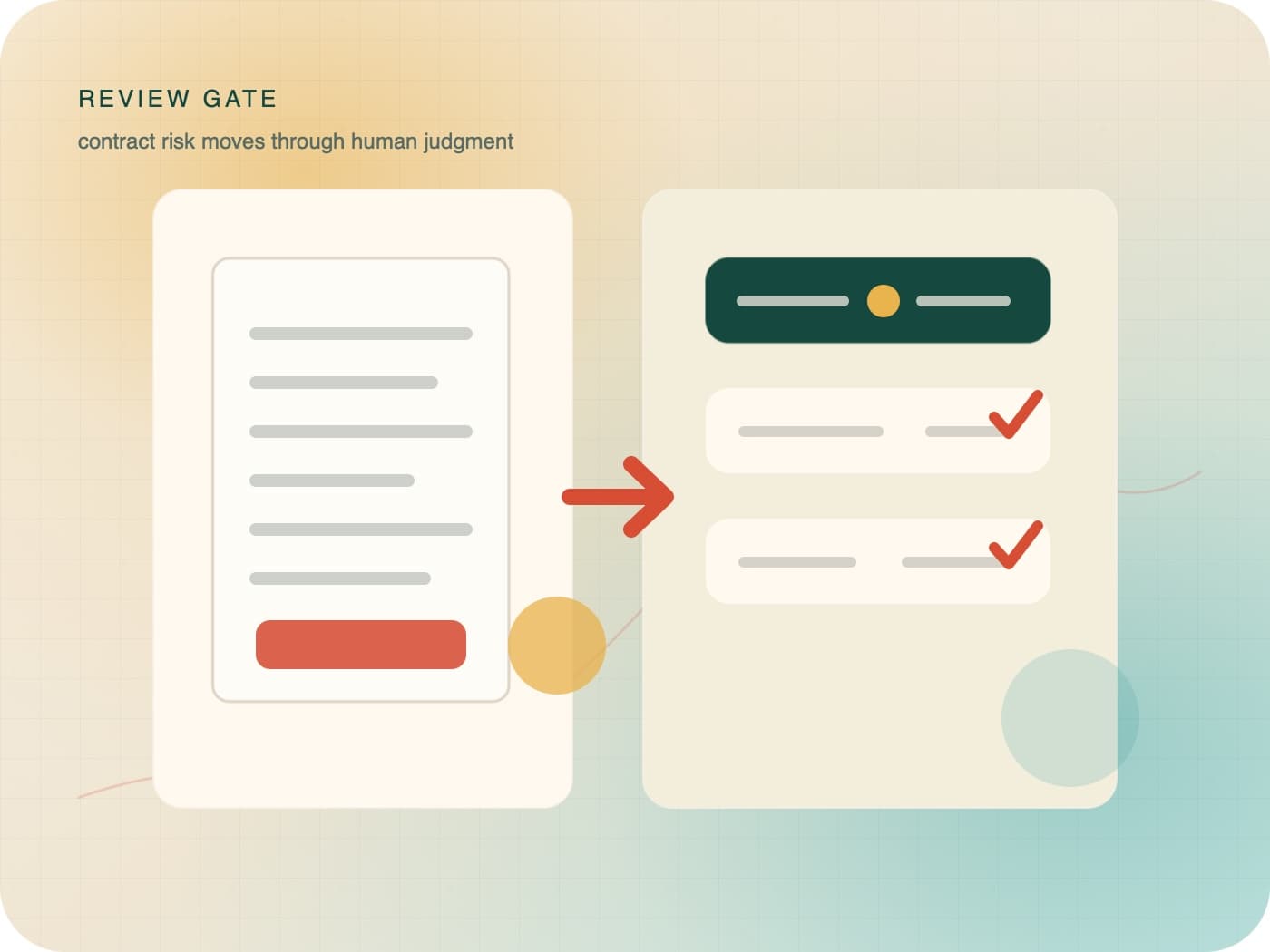
Review gate
AI output moves through clear human judgment before it reaches clients or teams.
Naïve adoption produces unreliable output that wastes more time than it saves. Reliable AI requires a system — structured prompts, guarded inputs, integrated review, and clear handoffs between humans and models. That system has to fit the way your departments already operate, not replace them with a chatbot bolt-on.
Done right, teams stop treating AI as a side tool and start using it as a controlled drafting layer inside work they already own.
Commercial outcomes
Each workflow starts with a baseline and a target, so the rollout is judged by operating value, not AI enthusiasm.
Turn recurring reports into structured drafts with reviewable inputs.
Remove copy-paste handoffs, status chasing, and repeat formatting.
Help teams triage, draft, and route more work without dropping judgment.
Make ownership, exceptions, and review criteria visible earlier.
The framing
Most AI vendors sell tools. We build the layer underneath: the workflows, review paths, approvals, and data movement that make AI output reliable enough to ship to a customer, a partner, or a regulator.
Five pillars hold it up.
Every output passes the same review path. Trust is engineered into the workflow, not assumed from the model.
Work is mapped before any prompt is written. The AI step lives inside a documented process, not next to it.
Owners sign off. Exceptions are explicit. Nothing ships to a customer, partner, or regulator without a human approval.
Inputs come from systems of record. Outputs return to systems of record. The workflow does not depend on copy-paste.
One operating model spans departments. New workflows reuse the same intake, review, approval, and audit primitives.
What it looks like
Every engagement ships a workflow with structured inputs, a review path, an approval gate, and a delivered artifact - not a chatbot bolt-on.
Facts, context, and constraints captured before any model call.
Model produces a first pass against a documented standard.
Operator checks output against a tiered quality checklist.
Owner signs off, or escalates the exception path.
Result lands in the system of record with audit trail.
What gets built
Map the work as it actually happens: inputs, handoffs, review loops, exceptions, and the places where AI can safely increase throughput.
Design practical AI-assisted workflows for legal, operations, finance, support, sales, and leadership teams without asking people to invent prompts from scratch.
Turn scattered know-how into reusable playbooks, templates, review gates, and operating rules that produce consistent output across the company.
Ship the workflow with team training, implementation support, adoption checks, and a simple measurement loop so it survives first contact with real work.
Visual operating model
The output is not just written advice. Teams need process maps, architecture views, review queues, and implementation screenshots that make the new operating rhythm easy to inspect.
Sample architecture
simulated
Slack
#sales-inbound channel mentions and DMs
~40 events / day
Lead triage
Classifies intent, scores against ICP, drafts a reply to confirm fit
model + tools · ~1.4s
AE review
Confirms ICP score and reply tone, escalates ambiguous fits
SLA < 15 min
HubSpot
Creates a Deal, sets stage, attaches the full message thread
CRM · system of record
Shared grounding layer
ops.console / workflows
sample · not client data
integrations
SlackGmailHubSpotNetSuiteLookerSnowflakeLive queue · awaiting human
updated 12s ago
Methodology
Clarify the company structure, service lines, constraints, tools, approval paths, and the business outcomes the engagement has to move.
Sit with the people doing the work and document the real sequence of inputs, judgment calls, reviews, rework, and final delivery.
Build the AI workflow: prompts, retrieval inputs, approval gates, exception paths, human review moments, and the success metric.
Train the team, pilot the workflow under real load, tune failure points, and hand over a documented operating rhythm.
Workflow examples
Legal
Sample workflowA sample legal workflow showing how messy contract requests can become structured intake, AI-assisted clause analysis, and exception-only partner review.
Sample workflow simulation. Not client data.
Contract review cycle
Messy state: Unstructured intake with unclear risk toleranceStructured state: Review packet routed by risk tier
Government & operations
Sample workflowA background-informed sample showing how public operations need structured records, role-based access, reporting consistency, and reviewable handoffs before AI belongs in the workflow.
Sample workflow simulation informed by founder background. Not presented as Claver Consult client data.
Deployment footprint
Messy state: Fragmented unit-by-unit recordsStructured state: Shared operating model across units
Field notes
Monthly · No noise
One useful note when there is something worth saying — concrete patterns from real workflow design, not tool hype.
A discovery call is 45 minutes. We’ll review the intake you submit, map your departments, and identify the two or three highest-leverage workflows worth automating first. hello@claverconsult.comif you’d prefer email.